Sunday, August 28, 2011

On your mark, Get Ready, Get Set, GO?!


Hurricane Basics

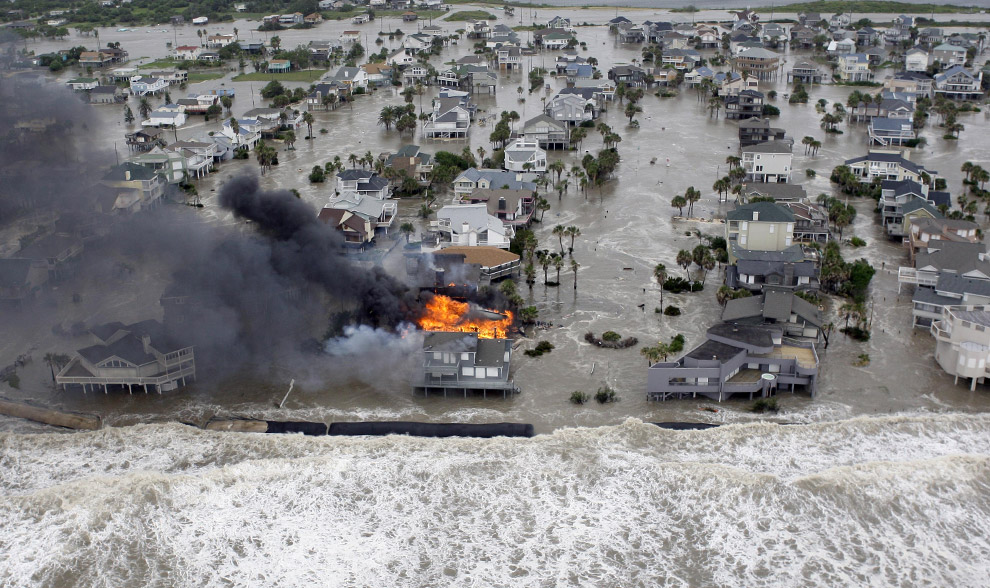
Hurricane Fran
Hurricane Fran 1996

The ingredients for a hurricane include a pre-existing weather disturbance, warm tropical oceans, moisture, and relatively light winds aloft. If the right conditions persist long enough, they can combine to produce the violent winds, incredible waves, torrential rains, and floods we associate with this phenomenon.

Each year, an average of eleven tropical storms develop over the Atlantic Ocean, Caribbean Sea, and Gulf of Mexico. Many of these remain over the ocean and never impact the U.S. coastline. Six of these storms become hurricanes each year. In an average 3-year period, roughly five hurricanes strike the US coastline, killing approximately 50 to 100 people anywhere from Texas to Maine. Of these, two are typically "major" or "intense" hurricanes (a category 3 or higher storm on the Saffir-Simpson Hurricane Scale).

Can you AIM A HURRICANE? try here


Hurricanes are severe tropical storms that

form in the southern Atlantic Ocean, Caribbean Sea, Gulf of Mexico, and in the eastern Pacific Ocean. Hurricanes gather heat and energy through contact with warm ocean waters. Evaporation from the seawater increases their power.

Hurricanes rotate in a counter-clockwise direction

around an "eye." Hurricanes have winds at least 74 miles per hour. When they come onto land, the heavy rain, strong winds and heavy waves can damage buildings, trees and cars. The heavy waves are called a storm surge. Storm surges are very dangerous and a major reason why you MUST stay away from the ocean during a hurricane warning or hurricane.

Things To Know Julia and Robbie: The Disaster Twins Disaster Supply Kit Pets and Disasters
How To Protect Your Home From Disasters Photos Canine Heroes

Storm Surge, the Coastal Killer.

NOAA Weather  Radio


Click image to activate Storm Surge the coastal killer. For more animation click here ( Surge animation with shallow continental shelf) or here (steep continental shelf).

Surge Vulnerability Facts

(evacuation map of Pinellas County)

  • From 1990-2008, population density increased by 32% in Gulf coastal counties, 17% in Atlantic coastal counties, and 16% in Hawaii (U.S. Census Bureau 2010)
  • Much of the United States' densely populated Atlantic and Gulf Coast coastlines lie less than 10 feet above mean sea level
  • Over half of the Nation's economic productivity is located within coastal zones
  • 72% of ports, 27% of major roads, and 9% of rail lines within the Gulf Coast region are at or below 4 ft elevation (CCSP, SAP 4-7)
  • A storm surge of 23 ft has the ability to inundate 67% of interstates, 57% of arterials, almost half of rail miles, 29 airports, and virtually all ports in the Gulf Coast area (CCSP SAP 4-7)


Family Disaster Plan


check markDiscuss the type of hazards that could affect your family. Know your home's vulnerability to storm surge, flooding and wind.

check markLocate a safe room or the safest areas in your home for each hurricane hazard. In certain circumstances the safest areas may not be your home but within your community.

check markDetermine escape routes from your home and places to meet. These should be measured in tens of miles rather than hundreds of miles.

check markHave an out-of-state friend as a family contact, so all your family members have a single point of contact.

check markMake a plan now for what to do with your pets if you need to evacuate.

check markPost emergency telephone numbers by your phones and make sure your children know how and when to call 911.

check markCheck your insurance coverage - flood damage is not usually covered by homeowners insurance.

check markStock non-perishable emergency supplies and a Disaster Supply Kit.

check markUse a NOAA weather radio. Remember to replace its battery every 6 months, as you do with your smoke detectors.

check markTake First Aid, CPR and disaster preparedness classes.


Disaster Supply Kit

Check boxWater - at least 1 gallon daily per person for 3 to 7 days

Check boxFood - at least enough for 3 to 7 days
— non-perishable packaged or canned food / juices
— foods for infants or the elderly
— snack foods
— non-electric can opener
— cooking tools / fuel
— paper plates / plastic utensils

Check boxBlankets / Pillows, etc.

Check boxClothing - seasonal / rain gear/ sturdy shoes

Check boxFirst Aid Kit / Medicines / Prescription Drugs

Check boxSpecial Items - for babies and the elderly

Check boxToiletries / Hygiene items / Moisture wipes

Check boxFlashlight / Batteries

Check boxRadio - Battery operated and NOAA weather radio

Check boxTelephones - Fully charged cell phone with extra battery and a traditional (not cordless) telephone set

Check boxCash (with some small bills) and Credit Cards - Banks and ATMs may not be available for extended periods

Check boxKeys

Check boxToys, Books and Games

Check boxImportant documents - in a waterproof container or watertight resealable plastic bag
— insurance, medical records, bank account numbers, Social Security card, etc.

Check boxTools - keep a set with you during the storm

Check boxVehicle fuel tanks filled

Check boxPet care items
— proper identification / immunization records / medications
— ample supply of food and water
— a carrier or cage
— muzzle and leash


Are you ready

Tuesday, August 23, 2011

SUPERFISH

MISSION: SUPERFISH

Marine biologist and award-winning filmmaker Rick Rosenthal set out to capture on film the biggest, fastest, most dangerous gamefish in the sea — the ancient creatures known as billfish.

The largest of all billfish is the marlin. They top speeds of 60 miles an hour on migrations that can span 9,000 miles. The largest, always female, weigh in at over 1,000 pounds, and are known as “granders.” Ernest Hemingway immortalized the grander in The Old Man and the Sea, the story of an elderly fisherman locked in a life and death struggle with this apex predator. To Hemingway’s great disappointment, he himself never landed a grander, although his novella captures the impact of this huge and graceful creature.


NATURE | Superfish | Sailfish Nursery | PBS by pbs_usa


WHAT IS A BILLFISH?

Just as eagles have done in the sky, billfish have dominated the seas as apex predators for years, and yet we know relatively little about them. Billfish include marlin, sailfish, swordfish and spearfish. Marlin, sailfish and spearfish are members of the family Istiophoridae, and swordfish are members of the family Xiphiidae. Billfish are best known for the elongated nasal bones that form their "bill". Like tunas, their bodies are also built for the endurance and speed needed to travel thousands of miles through the world's oceans in search of food.


Blue Marlin

Makaira nigricans (Atlantic) and M. mazara (Indian and Pacific)

Blue Marlin are found in all of the world's major oceans. They are one of the largest billfish species, and have been known to reach sizes of 1700 pounds (771 kg). Individuals over 350 pounds (159 kg) are most likely female. Atlantic blue marlin undergo rapid growth during the first year or two of their lives; however it typically takes 30 years for one to reach 1,000 pounds (454 kg). Blue marlin have the ability to make incredibly long journeys through the ocean. The record being a trip of 9,254 miles (14,893 km) from Delaware in the U.S. to the island of Mauritius off the southeast coast of Africa in the Indian Ocean.

Black Marlin

Makaira indica

Black marlin are found only in the Indian and Pacific Oceans. Like blue marlin, black marlin are known for making long distance migrations. One individual was recorded to have traveled 9,045 miles (14,556 km) across the Pacific Ocean from Australia to the Pacific coast of Costa Rica.

White Marlin

Tetrapturus albidus

White marlin are found in the Atlantic Ocean and in the Caribbean and Mediterranean Seas. They are among the smallest of the marlin, typically only reaching wei

ghts of 55 pounds (25 kg) and lengths of 5.5 feet (1.5 m). Individuals have been known to reach lengths of 7.5 feet (2.3 m) and weights of 180 pounds (82 kg). This species of marlin is the most frequently caught along the eastern coast of the U.S.

Striped Marlin

Tetrapturus audax

Striped Marlin are found throughout the Pacific and Indian Oceans and occassionaly on the Atlantic side of the Cape of Good Hope. These marlin are known for coming to the surface during strong winds and high waves, where they swim in the direction of the wind.

Sailfish

Istiophorus platypterus (Indo-Pacific) and I. albicans (Atlantic)

Sailfish are best known for their huge, sail-like dorsal fins. This fin can be up to twice the height of the body of the fish. They are the most commonly encountered of all the billfishes. Indo-Pacific sailfish are much larger than their Atlantic counterparts.

Spearfish

Tetrapturus pfluegeri (Atlantic longbill), T. angustirostris (Pacific shortbill) and T. belone (Mediterranean shortbill)

Though spearfish, the smallest of the billfishes, are found in all the world's oceans, they are rarely encountered in much of the world. They have the shortest bills of the billfish. Very little is known about these animals. It is believed that they have the shortest lifespan of the billfish, maturing at 2 years and living no more than 5 years.

Swordfish

Xiphias gladius

Swordfish are found in all of the world's oceans. They are easily identified by their flattened bills, shaped like the blade of a sword. They also differ from other billfish in that they have a single caudal keel, instead of two. They can reach sizes of 1200 pounds (540 kg). Similar to blue marlin, individuals that are over 300 pounds (136 kg) are most likely female. Swordfish have the ability to dive to 2,000 feet (610 m), although large individuals m

ay be seen basking at the ocean's surface during the day.

BF378469 Recapture

TBF hopes you all enjoy seeing where some of our tagged billfish have gone. These maps illustrate a small sample of the recapture data from our conventional

tagging program. TBF is proud to have captains, anglers, and mates eager to tag and report all their billfish catches. TBF could not have the largest private conventional tagging program and best recapture rates for billfish if it wasn't for you.

As a thanks, TBF will now will be releasing periodic posts of our recapture track maps throughout the year on Facebook and on our website (www.billfish.org). If you have any questions please let us know and keep on tagging! We would love to see and hear more of your tagging stories, contact us at tag@billfish.org.

*please note the "push pin" is where the billfish was originally tagged and the "fishing icon" is where billfish was recaptured.


Original billfish Information

Tag No#: BF378469

Date: 01/02/2007

Species and Location

Species: Swordfish

Location: Pompano Beach, Florida

Fish Information

Length: 60 Inches

Weight: 45 Lbs

Fight Time: HR 0 MIN 5 Fish Condition: Good

Bait: Dead

Hook removed? No

Angler

Ryan Goldman

Captain

Burt Moss

Boat Name

Purple Fever

Recapture Information

Days at large - 1 year, 11 months

Date: 12/06/2008

Location

Atlantis Canyon, New Jersey

Angler

Robert Burcaw


so........... What do you think?

Monday, August 22, 2011

As a MATTER OF FACT - review

Eureka videos are cool ! For even more stuff about... "stuff " Click here

Matter Attracts


Matter is conserved


Double check that


Even Harry Potter has MASSive problems


What do you think? got any examples of the Law of conservation of matter?

Or Movie majic that breaks the law?:

Submit for bonus points


Tuesday, May 24, 2011

Awards


Hey, MR V alumni... Let other students know what you learned in a MR V CLASS..Post it here!


Wednesday, May 18, 2011

Dah Dum....Dah Dum....Da Dum....Sharkbeat


Look at this map of shark attacks reported in the United States between 1670 and 2000. Which states have had the highest numbers of shark attacks?

Florida and California are very popular places to swim and to take beach vacations. Knowing this, why might these two states have had the highest numbers of shark attacks?


Just what is it that scares us so?

John Singleton Copley, Watson and the Shark, 1778. National Gallery of Art, Ferdinand Lammot Belin Fund 1963.6.1

John Singleton Copley's Watson and the Shark was inspired by an event that took place in Havana, Cuba, in 1749. Fourteen-year-old Brook Watson, an orphan serving as a crew member on a trading ship, was attacked by a shark while swimming alone in the harbor. His shipmates, who had been waiting on board to escort their captain ashore, launched a valiant rescue effort.

What do you think you know? Which of these "FACTS" are TRUE.. which are FALSE?


Most sharks are harmful to people.
Sharks must roll over on their sides to bite.

Sharks eat continuously.
Sharks prefer human blood.


Sharks are not discriminating eaters and scavenge the sea.


Whale sharks, the largest species of sharks, are voracious predators.

The great white shark is a common, abundant species found off most beaches visited by humans.


Sharks are not found in freshwater.

All sharks have to swim constantly.
Sharks have poor vision.

Sharks are hard to kill.
Most sharks cruise at high speed when they swim.


Sharks have peanut-sized brains and are in
capable of learning.

Shark meat is poisonous to people.

All sharks have to swim constantly.
Sharks are trash fish.
The biggest enemy to sharks is man.


CHECK HERE

Read the article in The St. Pete Times ....


They're back

By Terry Tomalin, Times Outdoors-Fitness Editor


Interactive Anatomy: The Great White’s Weapons


Welcome to RJD from R.J. Dunlap Marine Conservation on Vimeo.


Join an expedition


RJD Virtual Expedition 1: Departure and Deployment from R.J. Dunlap Marine Conservation on Vimeo.

Friday, May 6, 2011