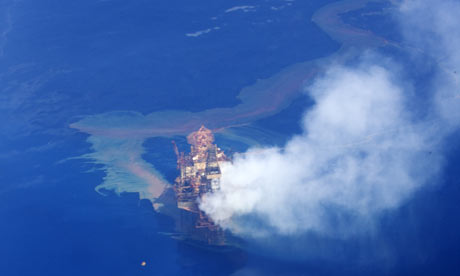
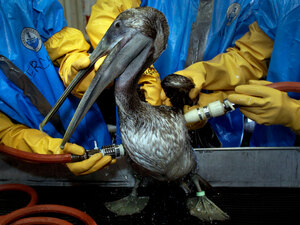
The gooey oil washing into the maze of marshes along the Gulf Coast could prove impossible to remove, leaving a toxic stew lethal to fish and wildlife, government officials and independent scientists said. Officials are considering some drastic and risky solutions: They could set the wetlands on fire or flood areas in hopes of floating out the oil.
They warn an aggressive cleanup could ruin the marshes and do more harm than good. The only viable option for many impacted areas is to do nothing and let nature break down the spill.
More than 50 miles of Louisiana's delicate shoreline already have been soiled by the massive slick unleashed after the Deepwater Horizon rig burned and sank last month. Officials fear oil eventually could invade wetlands and beaches from Texas to Florida. Louisiana is expected to be hit hardest.
On Saturday, a major pelican rookery was awash in oil off Louisiana's coast. Hundreds of birds nest on the island, and an Associated Press photographer saw some birds and their eggs stained with the ooze. Nests were perched in mangroves directly above patches of crude.
Plaquemines Parish workers put booms around the island, but puddles of oil were inside the barrier.
"Oil in the marshes is the worst-case scenario," said Coast Guard Adm. Thad Allen, the head of the federal effort to contain and clean up the spill.
Can't somebody get me outta' here !?! Also Saturday, BP told federal regulators it plans to continue using a contentious chemical dispersant, despite orders from the Environmental Protection Agency to look for less toxic alternatives. BP said in a letter to the EPA that Corexit 9500 "remains the best option for subsea application."
The EPA didn't immediately comment on BP's decision.
Oil that has rolled into shoreline wetlands coats the stalks and leaves of plants such as roseau cane — the fabric that holds together an ecosystem that is essential to the region's fishing industry and a much-needed buffer against Gulf hurricanes. Soon, oil will smother those plants and choke off their supply of air and nutrients.
Marshes offer a vital line of defense against Gulf storms, blunting their fury before they hit populated areas. Louisiana and the federal government have spent hundreds of millions of dollars rebuilding barriers that were wiped out by hurricanes, notably Katrina in 2005.
They also act as nursery grounds for shrimp, crabs, oysters — the backbone of the region's fishing industry. Hundreds of thousands of migratory birds nest in the wetlands' inner reaches, a complex network of bayous, bays and man-made canals
Video on the incoming Oil - Toxic Yuck
Not MY idea of a Bird Bath!!!
Seabirds are strongly affected by oil spills. A seabird may get covered in the oil. The thick black oil is too heavy for the birds to fly, so they attempt to clean themselves. The bird then eats the oil to clean its feathers and poisons itself. If workers have found sea birds that are not dead because of oil, they will take the birds to a cleaning center or captivity where they are kept in a facility because they can not live in the wild on their own. Animals that are in captivity because of an oil spill will be cleaned by professionals and volunteers. When a bird is in captivity, the oil will be flushed from its eyes, intestines, and feathers. The bird will be examined for any more injuries like broken bones, and it will take a medicine to prevent any more damage.
After the bird seems healthier, it will take a test on its abilities to float in the water and keep water away from its body. As soon as the bird passes its test, it will soon be let out into the wild.
The nonprofit Suncoast Seabird Sanctuary, Inc. is the largest wild bird hospital and bird sanctuary in the United States, based on the admission of up to 8,000 birds per year. It is set up to immediately triage, stabilize and administer fluids to oiled, malnourished, or injured birds. The birds would then need to be transported to a hazardous materials cleaning site. The Sanctuary has received thousand's of emails and calls from around the world from concerned groups and individuals.
As always your comments are appreciated and VERY welcome..
It is a Cousteau game, there are others right there too!
For a bit more advanced Marine and Environmental study start with Jason Note for kids:You do have to sign in - so you may have to check with a parent first...be cool and open when you use computers.
I have been teaching and preaching, searching and researching Environmental Responsibility /Stewardship / Sustainability and Education, knowingly and unknowingly, actively and passively for as long as I can remember.
I learned to love river waters when crossing bridges in old Fords with "nose-to-the-glass" anticipation.
I discovered their history page by page with Lewis and Clark.
I learned to predict what lies ahead by reading them from the stern of a canoe.
I was taught by them -guided by Hereclitus; “You can never step into the same river twice; for new waters are always flowing on to you.”(Greek philosopher remembered for his cosmology, 540-480BC)
Then I found where all my rivers went.
Oh Ocean, she was so scary at first- she was beyond power, beyond mystery, she was completely unfathomable from shore.
Books and television unlocked land-locked eyes and ears and imagination... and Cousteau became a Hero.
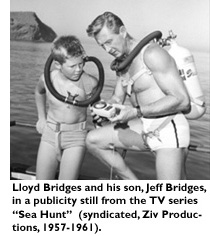
And of course, Sea Hunt! (OMG if Lloyd Bridges wasn't truly, secretly, really Aquaman then who was? )
Once I stepped into her surf, I never stepped out. I've been north and south and to the other side of the world, she is always there- waiting .
I have shared (some of) her secrets with others, sung her beauty to loved ones, splashed her laughs with children, and been uplifted by her buoyant, boundless promise in the simple solitude of a sunset swim.
The List of Will We Never Learn?
1) Arabian Gulf Spills
Note: This is currently the world's largest and the oil spill took place during the Gulf War when Iraqi forces deliberately destroyed oil tankers, wells and terminals.
• Location: Persian Gulf • Year: 1991 • Amount of Oil Spilled in Gallons and Liters: 520 million gallons (1.9 billion liters)
2) Ixtoc I Oil Well
• Location: Gulf of Mexico • Year: 1979 • Amount of Oil Spilled in Gallons and Liters: 140 million gallons (530 million liters)
NOTE: It took nearly 10 months for the responders to stop the oil from flowing in the IXTOC 1 accident. And this was a well that was in only about 164 feet of water. That allowed divers to be sent down to cap the well The Deep water Horizon is in 5000 feet of water
3) Atlantic Empress
• Location: Trinidad and Tobago • Year: 1979 • Amount of Oil Spilled in Gallons and Liters: 90 million gallons (340 million liters)
4) Fergana Valley
• Location: Uzbekistan • Year: 1992 • Amount of Oil Spilled in Gallons and Liters: 88 million gallons (333 million liters)
5) ABT Summer
• Location: 700 nautical miles from Angola (3,900 km) • Year: 1991 • Amount of Oil Spilled in Gallons and Liters: 82 million gallons (310 million liters)
6) Nowruz Field Platform
• Location: Persian Gulf • Year: 1983 • Amount of Oil Spilled in Gallons and Liters: 80 million gallons (303 million liters)
7) Castillo de Bellver
• Location: Saldanha Bay, South Africa • Year: 1983 • Amount of Oil Spilled in Gallons and Liters: 79 million gallons (300 million liters)
8) Amoco Cadiz
• Location: Brittany, France • Year: 1978 • Amount of Oil Spilled in Gallons and Liters: 69 million gallons (261 million liters)
9) MT Haven
• Location: Mediterranean Sea near Italy • Year: 1991 • Amount of Oil Spilled in Gallons and Liters: 45 million gallons (170 million liters)
10) Odyssey
• Location: 700 nautical miles (3,900 km) off of Nova Scotia, Canada • Year: 1988 • Amount of Oil Spilled in Gallons and Liters: 42 million gallons (159 million liters)
11) Sea Star
• Location: Gulf of Oman • Year: 1972 • Amount of Oil Spilled in Gallons and Liters: 37 million gallons (140 million liters)
12) Morris J. Berman
• Location: Puerto Rico • Year: 1994 • Amount of Oil Spilled in Gallons and Liters: 34 million gallons (129 million liters)
13) Irenes Serenade
• Location: Navarino Bay, Greece • Year: 1980 • Amount of Oil Spilled in Gallons and Liters: 32 million gallons (121 million liters)
14) Urquiola • Location: A Coruña, Spain • Year: 1976 • Amount of Oil Spilled in Gallons and Liters: 32 million gallons (121 million liters)
15) Torrey Canyon
• Location: Isles of Scilly, United Kingdom • Year: 1967 • Amount of Oil Spilled in Gallons and Liters: 31 million gallons (117 million liters)
The Exxon-Valdez oil spill in 1989 was the largest spill in United States history. It occurred in Prince William Sound, Alaska and spilled around 10.8 million gallons (40.8 million liters) and impacted 1,100 miles (1,609 km) of coast.
It isn't just the SIZE of the spill, but the NUMBER of spills Click on NOAA' s Incedent News and you just might be shocked.
And now, once again,
How dare they!
My Ocean belongs at once to no one and to everyone.
How dare anyone, anywhere, at anytime for any reason threaten, harm, despoil, and foul her, for the ocean is the source of life- your life, our life, all life .... my life.
Less than a year before the Deep Horizon, July 21, 2009 in the Gulf 20 miles off the Mexican Coast... " At least 18 oil workers were killed when a drilling rig hit an oil platform in stormy weather, spilling gas and oil into the Gulf of Mexico, the state-owned oil company Pemex said. Seven workers were still missing." (below left)
And as mentioned in an earlier MRV BEACH TEACH BLOG "SLICK OIL" the North Australian oil spill of last summer; "Conservationists warned yesterday that one of Australia's worst off-shore oil spills was killing wildlife and "massively contaminating" one of the world's last great wildnernesses. Amid a fourth attempt to plug the 64-day-old leak at the Montara drilling rig, the slick – which has already spread over an area 10 times the size of London – continued to expand..." (below right)
From The Huffington Post James Moore May 3rd, 2010
We might be powerless.
The oil flowing out from the seabed in the Gulf of Mexico may be under such great pressure that we do not possess technology to stop the tragedy. Chances are quite good we have no true sense of the dire nature of the situation. The facts that have been ascertained, however, lead to a dark scenario. We know that the blowout preventers did not work but we do not know why. There are theories, though. The Deepwater Horizon rig was floating on pontoons about 5000 feet above the floor of the Gulf. When drillers struck an oil deposit, the bit was reported to be at about 18,000 feet, which is approximately three and a half miles beneath the platform. Does science even know what kind of pressure can be encountered at that depth, under almost a mile of water and two and half miles of rock? BP and Transocean, which owns the rig, has said there was a maximum working pressure of 20,000 PSI but the system was able to handle a kickback pressure from gasses of about 60,000 PSI. The breakdown of the blowout preventers can be interpreted to mean the pressure coming up from the hole exceeded 60,000 PSI. Generally, various mixtures of mud circulate up and down the drill pipe to act as lubricants and equalize pressures encountered at great depth, and this process was said to be working at the time of the accident. Does this mean it's possible, even likely, that the Deepwater Horizon encountered pressures current technologies are not equipped to handle?
Although BP and Washington are trying very hard to convince the public that everything possible is being done to stem the flow of crude, there is seemingly little that might be accomplished. 5000 feet below the surface of the water with oil blasting out at tens of thousands of PSI, and wreckage from the giant rig scattered about, fixes are not easy to find. The latest plan is for a special funnel to be placed over the spout, which will then force the flow into a pumping channel. But how does a funnel get placed over the top of anything pushing at that kind of pressure? Consider that story to be an unrealistic solution.
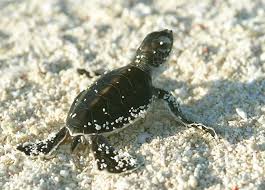
A well blowout in 1979 offers a bit of context; except the Deepwater Horizon horror show is already about to transcend what happened in the Bay of Campeche off the coast of Mexico. The Ixtoc 1 rig blew and began to spew crude that flowed uninterrupted for nine months. Before the well was capped, 3,000,000 barrels of crude had drifted north to Texas and the northern coast of Mexico. The endangered Kemps-Ridley turtle, which nests along the border beaches, had to be airlifted to safety and has only begun in recent years to recover in population.
The Ixtoc disaster, however, is a spit in the ocean compared to the British Petroleum apocalypse. Estimates are the current blowout is putting 200,000 gallons or 5000 barrels of crude per day into the waters of the Gulf. Ixtoc's blowout was not capped until two relief wells were drilled and completed at the end of those nine months, and regardless of optimistic scenarios from the federal government or BP, relieving the pressure on the current flow is probably the only way to stop the polluting release of oil. The only way to relieve that pressure is with additional wells. No one is going to honestly say how much time is needed to drill such wells but consider the scope of environmental damage we are confronting if it requires at least as long as Ixtoc. Nine months of 5000 barrels of crude per day ought to turn the Gulf of Mexico into a lifeless spill pond and set toxins on currents that will carry them to deadly business around the globe.
NOAA apparently believes the situation is on the verge of getting worse. A leaked memo suggests that the tangle of pipes on the ocean floor are covering and constraining two other release points. Pressure is likely to blow those loose and, according to NOAA, the gusher will increase by "orders of magnitude." In most interpretations, that phrase means a ten-fold rise in the flow, which will replicate the Ixtoc disaster in three days.
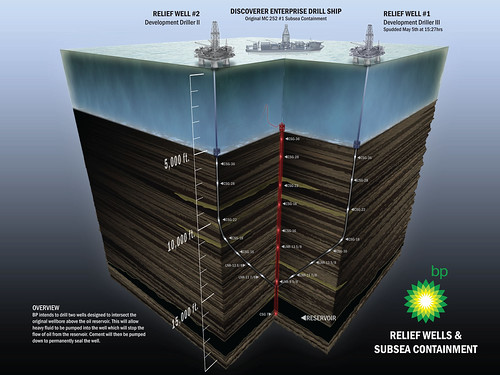
And there are no guarantees relief wells are the fix. That is a complicated project. They are drilled to intersect the main well and then concrete is forced down the holes to seal the leaking well. What do we do, if that doesn't work? Humans cannot function at 5000 feet of ocean depth and the mitigation efforts currently are being handled by robotic remotes. What is left to us as a solution other than an explosive device, which is often what is deployed during above ground blowouts? Given the pressures reported and the amount of flow, we may need a bunker-buster nuke to be placed over the wellhead. We can then begin to talk about the water pressures caused by burst at detonation and residual radiation. Is that a better or worse situation? Certainly, aquatic life in the Gulf of Mexico is doomed unless there is a reclusive genius to step forward and save us from our great failure.
The attorney general of Texas, Greg Abbot, informed reporters that it appears Texas will escape harm. Abbot's visionary powers must exceed his legal skills since there is no way to know when and even if the well will ever be capped. In fact, if there is no plug placed in the hole, it is not inconceivable that no part of the planet's oceans will escape harm. According to the non-profit, non-partisan Air and Waste Management Association, a quart of crude oil will make 150,000 gallons of water toxic to aquatic life. BP, which has been marketing itself as an energy company "beyond petroleum," is setting loose upon the planet what is quickly turning into humankind's worst environmental disaster. Tone-deaf politicians, especially from Texas, are trying to manage public fears, which is exactly what the state's former governor attempted in 1979. Bill Clements, who was one of the founders of SEDCO and owned the Ixtoc platform, originally described concerns as "much ado about nothing." As oil moved toward the pristine beaches of the Padre Island National Seashore, his advice was to "pray for a hurricane." I confronted Clements on his lack of concern and he stuck his finger in my chest and told me the state was not hurt. Thirty years later the tar balls still roll in with shifts of tide and wind and oil was everywhere on the beach for years.
Anyone who thinks this tragedy is not going to result in massive kills of marine life is either blind, ignorant, or in denial. The one scenario that we all refuse to confront is the possibility that it is beyond our capabilities to stop this undersea blast of oil. If that is the case, the flow continues until the pressure eases, which might be years. How much ecological injury will that cause our planet?
Nobody knows.
Comments are very welcome please post in the comments box. Maybe you have a solution.
It's a hot day, and you're hanging out at a park or other outdoor place in your town. You notice a group of kids who are a little younger than you. They're busy planting trees. You approach them and say hello. They are getting a little tired, so they sit down with you in the shade. They tell you that they are glad to be planting trees because trees are pretty and provide shade on a hot day like this. You know that they're right, but you also know there's more to it than that.
What would you tell them about the other benefits of planting trees that you've learned about?
How would you help them answer important questions like....
How do plants absorb carbon dioxide?
What is chlorophyll and what does it do?
How is glucose created?
Why do plants release oxygen?
Why might talking to plants REALLY be good for them?
You ask the kids in the park if they have ever heard about any other programs to plant trees in cities or other areas. What do they remember hearing? Do they remember what the purposes of these programs were? What benefits can students think of for planting new trees in one's community? In other parts of the world?
These sites might help you further explain the importance of trees in the environment.
How can you give a swamp, a beach, a forest or even part of one a "value?"
Dawn Anderson explains for the Environmental Literacy Council .....
Environmental resources and/or services are particularly hard to quantify due to their intangible benefits and multiple value options. It is almost impossible to attach a specific value to some of the experiences we have in nature, such as viewing a beautiful sunset. Problems also exist when a resource can be used for multiple purposes, such as a tree . The wood is valued differently if it is used for flood control versus if it is used for building a house. The quantity of a resource must also be taken into consideration because value can change depending how much of a resource is available.
An example of this might be in preventing the first " unit/bit/start" of pollution if we have a pristine air environment. Preventing the first unit of pollution is not valued very highly because the environment can easily recover. However, if the pollution continues until the air is becoming toxic to its surroundings; the value of preserving clean air by preventing additional pollution is going to be increasingly valued.
"Valuation can be a useful tool that aids in evaluating different options that a natural resource manager might face. Because ecological resources and services are so varied in their composition, it is often difficult to examine them on the same level. However, after they are assigned a value, an environmental resource or service can then be compared to any other item with a respective value. Ecosystem valuation is the process by which policymakers assign a value, monetary or otherwise, to environmental resources or to the outputs and/or services provided by those resources. For example, a mountain forest may provide environmental services by preventing downstream flooding.
Within economics, value is generally defined as the amount of alternate goods a person is willing to give up in order to get one (additional unit) of the good in question.
What would be a "fair trade"?
An individual's preference for certain goods may either be stated or revealed. In the case of stated preferences, the amount of money a person is willing to pay for a good determines the value because that money could otherwise be used to purchase other goods. However, value may also be determined by simply ranking the alternatives according to the amount of benefit each will produce. Revealed preferences can be measured by examining a person's behavior when it is not possible to use market pricing.
There are typically two ways to assign value to environmental resources and services ? use and non-use ? and there are approaches to measuring environmental benefits based on these defined values. When environmental resources or services are being used, it is easier to observe the price consumers are willing to pay for the conservation or preservation of those resources. Market or opportunity cost pricing can be used when there are tangible products to measure, such as the amount of fish caught in a lake. Replacement cost can also be used, calculated based on any expenses incurred to reverse environmental damage. Hedonic pricing will measure the effect that negative environmental qualities have on the price of related market goods. When evaluating non-use value, contingent valuation is employed through the use of surveys that attempt to assess an individual's willingness to pay for a resource that they do not consume.
The process of environmental resource or service valuation provides a way to compare alternative proposals, but it is not without problems. All valuation techniques encompass a great deal of uncertainty: flaws can exist in the methods of assigning value accurately due to a wide number of variables and it is difficult to compartmentalize and measure environmental and natural resources and/or services within an ecosystem that functions as an interconnected web.
Yet challenging, it allows policymakers to make decisions based on specific comparisons (typically monetary) rather than some other arbitrary basis. The government has placed increasing emphasis on cost-effective laws and projects; therefore, establishing a common measure by which to evaluate alternatives is essential.
March 30, 2008, The Environmental Literacy Council.
As always the comment box is open...........
What do you think?
How should be determine the value of ecosysytems?
for that matter WHO should be involved in the decisions?
Drilling off Florida's coast won't increase America's independence from foreign oil, lower gasoline prices or raise billions of dollars annually for the state. •
Those are among the predictable findings of a new nonpartisan report on offshore drilling commissioned by the Florida Senate president. It is inconceivable that any responsible state lawmaker still would consider leveraging the state's pristine shoreline — and the tourism customers it draws — for such little return. Yet Rep. Dean Cannon, R-Orlando, who is in line to be the next House speaker, is doggedly pushing a plan that could put drilling platforms within 10 miles of the west coast.
The report produced by a Tallahassee think tank offers some of the best information yet to refute the propaganda from an anonymous oil industry group, Florida Energy Associates, that wants Florida's ban lifted. The report shows that the most-generous industry estimates for what Florida could collect from drilling in state and federal waters is far less than $2 billion — the annual amount suggested by the energy group's economist.
The Collins Center for Public Policy produced "Potential Impacts of Oil & Gas Exploration in the Gulf" on behalf of the Century Commission for a Sustainable Florida, a group set up by the Legislature in 2005 and chaired by former St. Petersburg Mayor Rick Baker, a Republican. Senate President Jeff Atwater, R-North Palm Beach, asked the commission to take on the issue late last year due to concerns about a lack of neutral information on drilling.
The 40-page report uses a question-and-answer format to address 31 issues that have arisen since Florida Energy Associates began its push last year. It says the risk of a devastating oil spill off Florida's coasts has greatly diminished due to technology and safety precautions since the 1989 Exxon Valdez disaster. But it also acknowledges the risk remains whether the drilling occurs in state waters close to shore or in the federal waters of the eastern Gulf of Mexico.
Most striking: Researchers don't think there is even enough oil in state waters to sustain the country's gasoline needs for a week. Advances in seismic technology may make it easier to find natural gas deposits, the report said. But it's not been tested in either the eastern gulf or near Florida. And harvesting natural gas in Florida would displace American-mined coal as a fuel, not foreign oil. The impact on energy costs would be minimal.
The report also states the obvious: Lifting Florida's ban would make it more likely Congress would lift its 2006 ban on the more profitable resources farther out in the eastern Gulf of Mexico, which extends as much as 125 miles from Florida's shore. The industry's endgame may be to get the drilling ban in state waters lifted merely to make it impossible to continue with the ban in federal waters.
But the eastern gulf doesn't have nearly the deposits found in the federal waters of the central and western gulf — the areas that benefit Alabama, Mississippi, Louisiana and Texas. And none of those states have received windfalls anywhere close to $2 billion annually from offshore drilling.
If the federal ban was lifted, Florida's annual share of revenues could be as low as $20 million (based on traditional government estimates) to as high as $180 million (based on industry estimates), according to the report. New jobs would number between 1,000 to 2,500.
The report purposely does not estimate revenues from drilling in state waters, except to say they would likely be less than those of other states with greater deposits. Alabama generates the most income from near-shore production: $200 million a year. What does $200 million buy in Florida? Not much compared to a $66 billion state budget. Or compared to the potential risk to the No. 1 industry, tourism.
Supporters of drilling off Florida's shores are evoking a patriotic duty to solve America's dependence on foreign oil. Cannon warns of riots in the streets if Floridians cannot get food because there is no fuel for trucks to deliver to groceries. But these are the facts: The estimated deposits in Florida's state-owned waters aren't even enough to fuel America's needs for a week, and lifting the drilling ban would provide relatively little money for the state. It would open the beaches and the state's tourism industry to additional risk — regardless of new drilling technology. The Senate has the answers it needs to tell Cannon to forget about drilling.
Drilling inFlorida waters
The state owns submerged lands from the coast to 10 miles offshore in the Gulf of Mexico and three miles offshore in the Atlantic Ocean. Here are some statistics that speak to drilling issues.
100 million
Government estimates of barrels of oil in state- owned water
140 million
Barrels of oil the U.S. uses in a week, or 20 million barrels a day
Unknown
What Florida could collect from drilling in state-owned waters, though experts expect less than other gulf states because of geological formations.
$200 million
Average annual amount Alabama collects for drilling in its state-owned waters — the most of any gulf state.
$189 million
Amount the Florida Lottery is expected to raise this year to enhance the state's education offerings
$66 billion
Florida's 2009-2010 state budget
Source: Potential Impacts of Oil & Gas Exploration in the Gulf, Collins Center for Public Policy; 2009 Florida General Appropriations Act (SB 2600)
[Last modified: Mar 19, 2010 09:05 PM]
Students and guests are welcome and encouraged to respond in the comments section. Comments may be moderated.
What do you think?
How might this information help you form an opinion?
The Red mangrove (Rhizophora mangle) is the tallest of all local species. It grows to heights over 80 feet tall (25m). It has large broad leaves grow to 5 inches (12cm) and terminate with a blunt point. The leaves are waxy, dark green above and pale green below. The trunk and limbs have grey bark that covers a dark red wood. The key characteristics of the Red mangrove are the "prop roots" derived from the trunk and “drop roots” from the branches. The seedling or propagule is almost 6 inches long (l5 cm) and cigar-shaped.
The second tallest species is the Black mangrove (Avicennia germinans), reaching heights over 65 feet(20m). The elliptical, green leaves approach lengths of 4 inches (10cm) and are often encrusted with salt. The leaf undersurface is covered with dense hairs. The bark is dark and scaly. The key characteristics of the Black mangroves are the aerial roots known as pneumatophores born from underground horizontal cable roots. Living in oxygen deprived sediment more than 10,000 pneumatophores may be found on a single tree. The propagules are approximately one inch (2-3cm) long and lima bean shaped.
The White mangrove (Laguncularia racemosa) is the smallest species existing as a tree or shrub with maximum heights of 50 feet (l5 m). The leaf shape is a broad, flat oval rounded at both ends. Leaf lengths approach three inches (7cm). Two glands are found at the base of each leaf at the apex of the petiole. When growing in oxygen deprived sediment the White mangrove often develop peg roots which are similar to pneumatophores except they are shorter and more stout in appearance. The propagules are very small, usually less than 0.2 inches (0.5 cm).
The Buttonwood (Conocarpus erectus) is an associate of the community, but is more frequently found in the upland transitional zone. Its pointed leaves possess salt glands as openings alternating along the midrib on the underside of the leaf. Rough bark exists on older trees which is often covered with epiphytes (plants which live on other plants). Rather than producing seedlings that germinate on the parent tree, buttonwoods flower with the formation of a button-like seed case.
SEACAMP ASSOCIATION, INC. 1998 Florida Department of Education


 etlands' inner reaches, a complex network of bayous, bays and man-made canals