The Common Sandpiper ( Actitis hypoleucos )
 Sandpipers are familiar birds that are often seen running near the water's edge on beaches and tidal mud flats. The common sandpiper has a brown upper body and a white underside. When at rest its wingtips reach halfway back to its tail. The bird is a European and Asian species, but is closely related to the similar-looking spotted sandpiper of the Americas.
(National Geographic Society,1996-2010)
The Spotted Sandpiper ( Actitis macularia )
ORDER : Charadriiformes
FAMILY: Scolopacidae
The most widespread breeding sandpiper in North America, the Spotted Sandpiper breeds along the edges of nearly any water source throughout the northern half of the continent. It is at home around urban ponds as well as tundra pools.
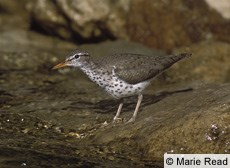 Copyright © 2010 Cornell Lab of Ornithology
The Osprey Pandion haliaetus

Ospreys are superb fishers and indeed eat little else—fish make up some 99 percent of their diet. Because of this appetite, these birds can be found near ponds, rivers, lakes, and coastal waterways around the world. Ospreys hunt by diving to the water's surface from some 30 to 100 feet (9 to 30 meters) up. They have gripping pads on their feet to help them pluck fish from the water with their curved claws and carry them for great distances. In flight, ospreys will orient the fish headfirst to ease wind resistance.
American Crocodile Crocodylus acutus
The American crocodile is considered an endangered species in nearly all parts of its North, Central, and South American range. Survey data, except in the United States, is po
Saltwater Crocodile Crocodylus porosus

Earth’s largest living crocodilian—and, some say, the animal most likely to eat a human—is the saltwater or estuarine crocodile. Average-size males reach 17 feet (5 meters) and 1,000 pounds (450 kilograms), but specimens 23 feet (7 meters) long and weighing 2,200 pounds (1,000 kilograms) are not uncommon.
Saltwater crocs, or "salties," as Australians affectionately refer to them, have an enormous range, populating the brackish and freshwater regions of eastern India, Southeast Asia, and northern Australia. They are excellent swimmers and have often been spotted far out at sea.
Nile Crocodile Crocodylus niloticus
The Nile crocodile has a somewhat deserved reputation as a vicious man-eater. The proximity of much of its habitat to people means run-ins are frequent. And its virtually indiscriminate diet means a villager washing clothes by a riverbank might look just as tasty as a migrating wildebeest. Firm numbers are sketchy, but estimates are that up to 200 people may die each year in the jaws of a Nile croc.
Sea Otter Enhydra lutris

This aquatic member of the weasel family is found along the coasts of the Pacific Ocean in North America and Asia. The sea otter spends most of its time in the water but, in some locations, comes ashore to sleep or rest. Sea otters have webbed feet, water-repellent fur to keep them dry and warm, and nostrils and ears that close in the water.
Falcons
Birds of prey (Order Falconiformes) include eagles, hawks, kites, the secretary bird, ospreys, and falcons. These birds have superb eyesight, strong legs and talons, a sharp, hooked bill and are adept hunters. Birds of prey are primarily carnovires (that is, they feed on other animals).
- Kingdom: Animalia
- Phylum: Chordata
- Class: Aves
- Order: Falconiformes
The Order Falconiformes contains the following subgroups:- Family: Sagittariidae (secretary bird)
- Family: Pandionidae (osprey)
- Family: Accipitridae (kites, eagles, hawks)
- Family: Falconidae (falcons)
There are LOTS OF FALCONS

- The Common Kestr el, found in Europe, Asia, and Africa
- The smaller Lesser Kestrel, found in southern Europe, India, and Mediterranean Africa
- The American Kestrel, found in North America and South America
- The Fox Kestrel, found in Equatorial Africa
- The Gray Kestrel, found in Central to Southern Africa
- Dickinson's Kestrel, found in Eastern to Southern Africa
- The Greater Kestre l, found in Eastern to South Africa
- The Madagascar Kestrel
- The Banded Kestrel, found on Madagascar
- The Seychelles Kestrel
- The Mauritius Kestrel
- The Spotted Kestrel, found in Indonesia
- The Nankeen Kestrel, found in Australia and New Guinea
- Lesser Kestrel, Falc o naumanni
- Common Kestrel, Falco tinnunculus
- Madagascar Kestrel, Falco newtoni
- Mauritius Kestrel, Falco punctatus
- Seychelles Kestrel, Falco araea
- Spotted Kestrel, Falco moluccensis
- Nankeen Kestrel, Falco cenchroides
- American Kestrel, Falco sparverius
- Greater Kestrel, Falco rupicoloides
- Fox Kestrel, Falco alopex
- Grey Kestrel, Falco ardosiaceus
- Dickinson's Kestrel, Falco dickinsoni
- Banded Kestrel, Falco zoniventris
- Red-necked Falcon, Falco chicquera
- Red-footed Falcon, Falco vespertinus
- Amur Falcon, Falco amurensis
- Eleonora's Falcon, Falco eleonorae
- Sooty Falcon, Falco concolor
- Aplomado Falcon, Falco femoralis
- Merlin Falcon, Falco columbarius
- Bat Falcon, Falco rufigularis
- Orange-breasted Falcon, Falco deiroleucus
- Eurasian Hobby, Falco subbuteo
- African Hobby, Falco c uvierii
- Oriental Hobby, Falco severus
- Australian Hobby, Falco longipennis
- New Zealand Falcon, Falco novaeseelandiae
- Brown Falcon, Falco berigora
- Grey Falcon, Falco hypoleucos
- Lanner Falcon, Falco biarmicus
- Laggar Falcon, Falco jugger
- Saker Falcon, Falco cherrug
- Black Falcon, Falco subniger
- Gyr Falcon, Falco rusticolus
- Taita Falcon, Falco fasciinucha
- Prairie Falcon, Falco mexicanus
- Peregrine Falcon, Falco peregrinus
-
- Barbary Falcon, Falco (peregrinus) pelegrinoides

There are even two types of Peregrine Falcon ... or 17 types, depending on who you ask??
The Peregrine Falcon (Falco peregrinus), also known simply as the Peregrine, and historically as the "Duck Hawk" in North America, is a cosmopolitan bird of prey in the family Falconidae.

It is a large, crow-sized falcon, with a blue-gray back, barred white underparts, and a black head and "moustache". It can reach speeds over 322 km/h (200 mph), making it the fastest animal in the world. As is 
Experts recognize 17–19 subspecies, which vary in appearance and range; there is disagreement over whether the distinctive Barbary Falcon is a subspecies or a distinct species.