FIZIKS IZ FUN( Much of this material is from The Annenberg Foundation with great appreciation.They have SUPER stuff.. support them by visiting and learning more about them.
http://learner.org/ and http://www.learner.org/about/legal_policy.html )
Americans are wild about amusement parks. Each day, we flock by the millions to the nearest park, paying a sizable hunk of money to wait in long lines for a short 60-second ride on our favorite roller coaster. The thought prompts one to consider what is it about a roller coaster ride that provides such widespread excitement among so many of us and such dreadful fear in the rest? Is our excitement about coasters due to their high speeds?
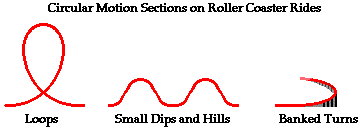
Absolutely not! In fact, it would be foolish to spend so much time and money to ride a selection of roller coasters if it were for reasons of speed. It is more than likely that most of us sustain higher speeds on our ride along the interstate highway on the way to the amusement park than we do once we enter the park. The thrill of roller coasters is not due to their speed, but rather due to their accelerations and to the feelings of weightlessness and weightiness that they Roller coasters thrill us because of their ability to accelerate us downward one moment and upwards the next; leftwards one momen
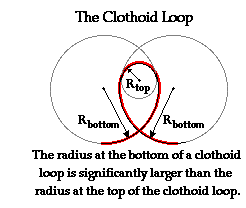
t and rightwards the next. Roller coasters are about acceleration; that's what makes them thrilling. The centripetal acceleration experienced by riders within the circular-shaped sections of a roller coaster track. These sections include the clothoid loops , the
sharp 180-degree banked turns, and the
small dips and hills found along otherwise straight sections of the track.produce.
The
Clothoid Loop is is the STAR PERFORMER at the amusement park! It is truly out of this world.

You've bought your ticket and boarded the roller coaster. Now you're barreling down the track at 60 miles per hour, taking hairpin turns and completing death-defying loops. Your heart is in your throat and your stomach is somewhere near your shoes. The only thing separating you from total disaster is a safety harness...but are you really in danger?
The designers of the roller coaster carefully crafted this thrilling ride to be just that, but you're actually in less danger than you think. You face a greater threat of injury playing sports or riding a bike than you do on a park ride. Amusement park rides use physics laws to
simulate danger, while the rides themselves are typically very safe.
How do physics laws affect amusement park ride design? In this exhibit, you'll have a chance to find out by designing your own roller coaster. Plan it carefully--it has to pass a safety inspection.You can also experiment with bumper car collisions.
Check the physics glossary to find out more about the terms used in this exhibit. Just click on
Ready to roll? Go on to the first ride: The Roller Coaster.
Or your can go to the Start page...... Zoom
You could of course start by designing your own Roller Coaster,,,,

At any time you can change rides...

Carousels are not considered "thrill machines" by any stretch of the imagination. Still, carousels are as reliant on the laws of motion as their more exciting cousins, the roller coasters. It's theoretically possible that, allowed to spin out of control, a carousel could gain enough speed so that the riders would be thrown off. Thankfully, runaway carousels are not the least bit common.

Newton's third law of motion comes into play on the bumper cars. This law, the law of interaction, says that if one body exerts a force on a second body, the second body exerts a force equal in magnitude and opposite in direction on the first body. It's the law of action-reaction, and it helps to explain why you feel a jolt when you collide with another bumper car.

Galileo first introduced the concept of free fall. His classic experiments led to the finding that all objects free fall at the same rate, regardless of their mass. According to legend, Galileo dropped balls of different mass from the Leaning Tower of Pisa to help support his ideas.

Pendulum rides are a little like the swing sets you might remember from your childhood. Swings give you a feeling of flying in a controlled manner. You pump your legs to provide enough force to increase the height of the swing's arc, and enjoy the increased velocity of the downward swing. When you stop pumping, the swing gradually slows and then stops.
Ride Safety depends on getting the "math" right don't ya know.
Going on amusement park rides is one of the safest forms of recreation. According to the International Association of Amusement Park Attractions, you are more likely to be injured when you play sports, ride a horse, or even ride a bicycle. Statistics show the occurrence of death to be approximately one in 250 million riders.
Get data on Roller Coasters from all over ....You can check their claims ...
"Fastest !! " (? really ?)
"Greatest Acceleration !!" ( can you prove it?)
"Highest Speed !!" (is it possible?)
...simply do the Math ! Use the right equations and you can calculate if you are really getting your money's worth
Many of the best amusements are exciting because you can "sense" the feeling of flight. You can find out more about the Fundamentals of Flight here in ..... FLIGHT , THE BASICS f
rom the Smithsonian. 

The National Business Aviation Association.
So... What do you think? ... AMUSING?
Think about velocity, momentum, impulse, force, speed, acceleration, Newton, Galileo ... algebra, mathematics, geometry ....
The next time you get on a new amusement ride, do you hope that the designers paid attention in class?
 Destruction by Earth, Water, ... and ?
 ... Fire