Sunday, January 10, 2010

Good Golly Goldy


Into the tank you go little fishy

When you first put your new goldfish in their new tank, do not just pour them in. Instead place the bag inside the tank and let the water temperature equal out. Gently and gradually mix in the water and release the fish carefully. It is a good idea to buy a couple of fish (even if you plan to get much more) and test them out in the water, before you buy more, you won't know the reaction until you try it.

If you ever need to catch your fish once they have been living in their tank, limit the use of your hands. A fish's scales can be damaged very easily and disease can be brought upon quickly. Use a jar or get a fish net that will fit in your aquarium from the pet shop. Fish should be out of the water for the shortest time possible, they cannot breathe air and will die very quickly if left out of water.


Uggggh, My tank is ICKY!

Changing the Water

Goldfish are natural born pigs. They are messy. And they eat a lot. Thus creating the biggest obstacle for many goldfish keepers-the water quality. Like most fish, goldfish prefer to live in clean water. They can tolerate a wide range of pH, but prefer neutral to slightly basic water.

You should change the water in the fish tank as regular as you can. It is better to change 15-25% water every couple of weeks rather than wait for the tank to get really dirty and chang e it on ly then. The easiest way is to siphon the water out using a tube, when doing this, aim the tube at the bottom of the tank to clean up the waste that accumulates in the bottom of the tank.

All you need to do this is some plastic tubing and a bucket that you pla

ce below the water level in the tank. Place one end of the tube in the tank and suck the water, stop before it hits you mouth and aim the tube into the bucket that is below the fish tank, the water will continually pump into the bucket. (http://www.goldfishcare.org/)

For simple step by step instructions check here ...... CLEAN UP


For a detailed view of how to clean an Aquarium watch this video.


How to Clean an Aquarium -- powered by eHow.com


Goldfish - But what kind?

Kingdom? Phylum? Class? Order? ...

Goldfish are members of the fish family Cyprindae. They share this distinction with many thousands of other fish, like the Barbs, Red Tail Shark, Rasboras, and more. The scientific name of the goldfish is Carassius auratus. The name Carassius refers to many of the Carp family, and the auratus literally means 'overlaid with gold.' Along with Koi and pond carp, goldfish make up a large portion of this group of fish.

Goldfish come in many shapes and sizes. The 'common' goldfish more closely resembles the many species of carp found in ponds and lakes all over the world. Goldfish originally derived from temperate Asia, but have been introduced to all parts of the world. Many cultures began to 'domesticate' the goldfish, as long as 1300 years ago. They selected for a variety of genetic traits, like color, fin shape, and body shape. The result of this selective breeding allows the myriad of goldfish types available to us as hobbyists today. The typical common goldfish, also sold as feeder fish a many pet stores, appears much as its wild natural great grandfather would have appeared in Asia. However, all the fancy variations, veil-tails, bubble-eyes, orandas, etc., are all strains developed through selective breeding, and do not occur in nature in that form naturally.
( http://www.aquariumhobbyist.com/articles/Goldfish.html )


Healthy steps

isn't ichthyology interesting?

Try this too...............


Here is another website a student (Allie) suggested for Goldfish

the comment box is open?


What do you think?


How could you improve this activity?


What more would you like to learn?

Tuesday, December 29, 2009

Marine and Environmental Science Presentations


Everyone worked diligently to get the message across ...

Our Marine Scientists presented the "What and How" for protecting and saving our National Marine Sanctuaries.


Our Environmental Scientists presented data from experiments showing WHAT and HOW individuals can protect in
our environment and save resources at the same time.


This is the "click-on" to see lots of great presentations in a Slideshow


The comment box is open.....


What do you think?


What else can we do to protect and save our sanctuaries and resources?


How can you make a difference?


HAPPY NEW YEAR!!

Sunday, December 13, 2009

In the scale of things ...

An example of a Water Cycle project ....


Now, on with the FISH >>>>>>>>>>>


Here are some interesting and challenging quizzes .. a bit fishy I'd say

Quiz 1: Everything you always wanted to know... right ?

Quiz 2: Great White shark quiz.... gulp!

Quiz 3: lions and TIGER SHARKS and bear .....oh my!


Some more fish "stuff"...

Bull Shark


What is a fish? (continued)

Some taxonomy - Classification

Sharks Skates and Rays ( NOT the baseball team)


Bony Fish


The comment box is open...

How did you do on the quizzes?


What did you learn in the videos?

Tuesday, December 8, 2009

WHAT' S THAT SEA CREATURE ?

Marine Species Identification Taxonomy.

This site Marine Species Identification Portal will get you started.


(If you struggle, you can always go to GOOGLE, and enter...

" kingdom phylum class order family genus species "

followed by the name of the species you want to classify.)


At this site you can QUIZ yourself about different Marine Species you might see on a Caribbean Dive adventure ... that's right, a fun quiz.


the Comment box is open.......

let me know how your search went and what you discovered.

(psssst... How did you do on the quiz?)

Sunday, October 25, 2009

The Home Environment: We have some issues

HOME
HOUSE RULES

All matter is limited, finite.
All matter begins with a star - like energy.
All “usable” energy begins with a star - like matter.
Both matter and energy can be resources.
What does the word “ Re – source” - mean?
Nature recycles naturally
What does the word “Re - cycle” mean?
Why / how are resources limited ? limited resources

All matter recycles (Law of Conservation of mass/matter)
Whether we want it to or not
Whether it’s “good” or “bad” is a human judgment
Some cycles take a long time (rock cycle animated)
Some cycles can happen overnight (H2O cycle animated)
Humankind interacts with these cycles in some way – directly or indirectly.
2 ways to Calculate your interactions. Simple (suggested) Complex

It takes energy to do anything
It takes energy to do everything
Energy recycles ! (Law of Conservation of Energy)
Energy is originally “solar” – in some form
Solar Energy “arrives” at Earth at a “constant rate,” the Solar Constant
Energy can be stored


Energy loses “usability” when changing forms.
What is entropy ? (a bit complicated)
Every energy expenditure has a cost.
Use it AND lose it.
The energy “cycle” can be simple, complex or beyond humankind time-scale.

Humankind may increase, decrease, or have no effect on the amount or rate of a cycle.
Humankind interacting with a cycle may be positive, negative, or neutral.

Science, is a process that observes, measures, models and tests the cycle(s), the biosphere and our interactions. Scientists look for patterns, and changes in patterns in order to make predictions.

If ___________________________,
(Increase, decrease, stay the same)

then _________________________ .
(Increase, decrease, stay the same)


Search and locate an issue most important to you. These are simply good starting points, jumping off points into some very deep waters ...... but you can do it.

After all, it is the only home we have.

A quick refresher, What's it all about?

A broad overview of many environmental issues, resources, and documentation try

Environmental Literacy Council
Click on their Site Map at the top of the page FOR A VERY LONG LIST of topics and issues or
Start by clicking of the MAin headings on the left side of the page.

GREENPEACE's What We Do Page

Carbon dioxide in the atmosphere (animation 1) (animation 2)
© 2009 Annenberg Media.
Air pollution
Ocean surface temperatures (animation1)
Tropical deforestation
Landfills and "Stuff"
Ogallala Aquifer
Oil depletion (5 predictions)
Ozone pollution Ozone2 Ozone animation
Electricity
The Solar Constant ( what if.. ?)

Off shore Oil Drilling ( see previous Blog: Slick Oil)


Overfishing New Overfishing site 1
Polar ice caps (melting)
Pesticides (a cycle) ground water pollution
Population (complex)
Recycling
Nuclear power
Species Diversity
Urban sprawl
The Nitrogen Cycle
Potassium (cycle) and Phosphorus (cycle) SOIL
Carbon cycle (animation 1)
Freshwater and water pollution


Other ........... ?


These are just some of the issues facing the Biosphere (of which you are a part).
Will you let others determine, define, and deal with these issues for their own interests, or will you take part for your interests? Your understanding, or lack of it, about how science works will make a big difference in the future of the biosphere – for better or for worse.


The comments box is open.

What issue are you most interested in?


What is your If...Then... Prediction?


What more would you like to know?

Monday, October 19, 2009

ALIENS INVADE !!!!

Lionfish Invade U.S. WATERS

from: The Lionfish Invasion! National Ocean Service. NOAA. revised March 2008


Local divers off the coast of North Carolina were not expecting to see what they found one day in August 2002--the exotic and beautiful lionfish, common to the warm waters of the western Pacific, but unknown at that time as residents of the Carolina coast. They provided the first solid evidence that lionfish were in the Atlantic--an actual specimen that they collected. A year later, scientists had documented 19 lionfish sightings at eight locations along the North Carolina continental shelf. By then, lionfish were also being observed off the coasts of Florida, Georgia, and South Carolina. Juvenile lionfish were also showing up off Bermuda and even as far north as Long Island, New York! Since then, many more United States divers have reported sightings of the distinctive fish. Between 2000 and 2003, 49 lionfish sightings were reported at 16 different shipwrecks and natural hard bottom locations. During a summer 2004 research expedition, NOAA scientists collected 155 lionfish at 19 different locations off the North Carolina coast alone. The jump in numbers and distribution over such a short time, plus sightings of juveniles smaller than those sold for aquaria, strongly indicate that the lionfish is reproducing in the Atlantic Ocean. If this is true, it's the first time that a western Pacific fish has populated the waters of the U.S. Atlantic coast.


How did lionfish get into the Atlantic Ocean ?

Reportedly, six lionfish were accidentally released in Biscayne Bay, Florida, when a beachside aquarium or nursery broke open during Hurricane Andrew in 1992. It's likely that even more have been released on purpose when people no longer want them as aquarium pets because they grew too large for the aquarium, or they learned the hard way that lionfish will eat their other fish! The swift and warm Gulf Stream, which likely transported buoyant lionfish eggs and larvae from Florida northward, helped the lionfish's Atlantic journey.


The red and black dots are locations in the Atlantic Ocean where lionfish have been reported as of May 2003. Notice that sightings are few north of Ca
pe Hatteras. Because lionfish are normally found in subtropical and tropical waters, their distribution is limited in the Atlantic by the colder temperate waters north of Cape Hatteras, where the warm Gulf Stream flows away from the continental shelf. (Photo credit: Paula Whitfield)

However, from north Florida upward, the waters along the coastline are too cold in the winter for lionfish to survive. Scientists expect them to survive the winter only at water depths greater than 120 ft because this is where the Gulf Stream has influence all year long. Very importantly, the types of predators and competitors present in the marine community in the Atlantic are very different from the native range of the lionfish. These are a couple of the reasons why scientists are paying so much attention to the lionfish invasion. Generally, species like the lionfish have not been perceived to pose a significant threat to marine ecosystems because they were not likely to survive long. Research on this topic has been minimal, however, so it is hard for scientists to answer questions such as:

It's pretty unusual for non-native, tropical marine fishes, like the lionfish, to establish themselves at this latitude. In Florida waters and along the continental shelf near the Gulf Stream the temperatures are very similar to the lionfish's native waters.


The warm Gulf Stream current (in red) may have dispersed lionfish as far as North Carolina and Bermuda, where water temperature is similar to their native habitat. Lionfish larvae may have been carried in the Gulf Stream to the northeast in a similar wa


For now, reef communities in the western Atlantic Ocean are unlikely to be in much danger, since the number of lionfish is still relatively small. If the population grows large, though, lionfish could damage the native ecosystems. At the same time, other factors are already causing stress to these ecosystems, and these stress factors or "stressors" tend to favor the lionfish's expansion.

Lionfish also are believed to pose particular risks to the local environment. They are hungry predators that feed on practically anything that swims. They can easily devour the young of important commercial fish species, such as snapper, grouper and sea bass, many of which use the region's "live bottom" reefs as nursery grounds. Lionfish are ambush predators and may use their outstretched, fan-like pectoral fins to "corner" their prey. They don't sting their prey, though. Their venomous spines are used mostly for defense. Scientists are concerned that lionfish could seriously reduce the numbers of prey species and/or compete with other reef predators. When a new species is introduced in an area, it can take over the niche, or role, of a native species in its ecosystem, thus squeezing it out--this process is called competition. Another important factor is that native prey species lack of experience in confronting the intimidating lionfish might make the lionfish a more effective predator.

Is the Aquarium Trade to Blame?

The aquarium trade appears the most likely vector for the introduction of lionfish into U.S. waters, but the lionfish's introduction into the Atlantic remains something of a mystery. Recent research indicates that a number of other tropical aquarium fish are currently surviving off the coast of Florida. Also, the color patterns of lionfish sighted off the Atlantic coast of the U.S. are similar to those from the Philippines, where many lionfish are collected for the aquarium trade.

In Europe imports of a wide range of popular wild-caught tropical fish have been restricted of banned in 2008 Import Directive. All European Union Member sgtates and some members of the European Economic Union including Norway were required to put regul;ations in place to implement this directive by May 2008. The United States is considering similar bans on aquarium fish imports.

Scientists say it is impossible to determine if the lionfish released in 1992 account for the species invasion of Atlantic Ocean. Some scientists have suggested that lionfish entered Atlantic waters when larvae or juvenile fish were trapped in ships moving from the Pacific to the Atlantic and were released when the ballast water was pumped out.

However, there is no evidence to support ballast water as the source for the lionfish invasion, although it is a common source of aquatic alien species introductions generally. Further, although lionfish have been introduced into the western Mediterranean, probably through the Suez Canal, there is no evidence that they crossed the Atlantic or that they entered the Atlantic through the Panama Canal. Besides, it is very unlikely that the tropical lionfish could survive a journey across the cold water between the two oceans. (http://oceanservice.noaa.gov/education/stories/lionfish/lion03_blame.html)


Another Juliane link suggestion right HERE. ALIENS EVERYWHERE !!!!

Sunday, October 18, 2009

It's not simply global warming... IT's CLIMATE CHANGE


Does Earth's climate system have an 'Achilles' heel'?

Here is a simplified description of some basic ocean-atmosphere dynamics that regulate Earth’s climate:

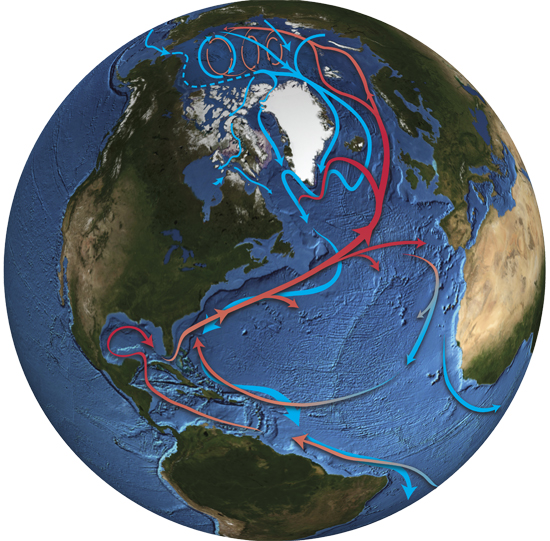
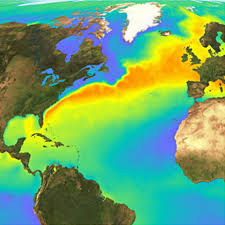
The equatorial sun warms the ocean surface and enhances evaporation in the tropics. This leaves the tropical ocean saltier. The Gulf Stream, a limb of the Ocean Conveyor, carries an enormous volume of heat-laden, salty water up the East Coast of the United States, and then northeast toward Europe.


Two views of the Gulf Stream
--------->


The global ocean is not a static pond, but a body in constant motion. Winds blow across its surface, generating waves and currents, while the pull of gravity gently sloshes it back and forth in a lunar rhythm of tides. But beneath these familiar surface motions is a seemingly mysterious process which has major implications for Earth's climate: the Great Ocean Conveyor (also called the thermohaline circulation).


The Conveyor is one of the great unknowns in humanity's unintentional climate change experiment. Surface water, warmed at the equator, moves to high latitudes where it releases heat to the atmosphere. As a result, the water cools - becoming denser - and sinks to the deep ocean. Deep water slowly travels through the oceanic abyss, eventually mixing up to the surface in distant parts the world, as much as 1000 years later.

This oceanic heat pump, is an all important mechanism for reducing equator-to-pole temperature differences. It moderates Earth’s climate, particularly in the North Atlantic region. Conveyor circulation increases the northward transport of warmer waters in the Gulf Stream by about 50 percent. At colder northern latitudes, the ocean releases this heat to the atmosphere—especially in winter when the atmosphere is colder than the ocean. The Conveyor warms North Atlantic regions by as much as 5° Celsius and significantly moderates average winter temperatures.


The transfer of energy, heat, by the great Ocean Conveyor is what lets Norway, which is as far north as Manitoba Canada have annual temperatures 20 degrees warmer. If not for the North Atlantic loop of the Conveyor, European winters would be much colder. London would be like Laborador, Berlin might have the climate of Edmonton Alberta, which lies at the same latitude, while Stockholm might be more like Nome, Alaska.

(CBS/AP) OCT 16, 2009
The North Pole will turn into an open sea during summer within a decade, according to data released by a team of explorers who trekked through the Arctic for three months.

NBC Nightly News Channel - Oct. 15, 2009
The Arctic Ocean will be an "open sea" almost entirely free from ice within just t
en years. Ice over during the summer months will have entirely disappeared within 20 years, but most of the decrease will happen before 2020.


So Santa needs a new home ... What else?

Unfortunately it may get even more confusing...


More like

Out of the frying pan and in to the freezer ?


In 2005 Nature , published the results of a study showing that the Gulf Stream current (the one that keeps Europe warm despite the fact that the UK is as far north as Hudson Bay) has slowed down by about 30% since 1957. The study noted that the slowing has mostly happened in the years since 1998.

Further studies indicate that during that time due to all the fresh water runoff from melting ice, North Atlantic waters have become steadily less salty in the places where cold, salty water is supposed to sink, starting the Great Conveyor. Fresher water is less dense than ocean water and does not sink as readily. The Great Conveyor is slowing down.


Records and evidence of past climates—from deep-sea sediments and ice-sheet cores—show that the Conveyor has slowed and shut down several times in the distant past. This shutdown stopped the heat transfer to the North Atlantic and brought about colder climates and mini -Ice Ages. One earth scientist has called the Conveyor “the Achilles’ heel of our climate system.” (Gagosian, Robert B. Woods Hole Oceanographic Institution updatedSeptember 3, 2009)

Something is throwing the climate out of balance. Computer models and scientists agree that it appears to be human activity and increased greenhouse gasses. The warming and freshening (i.e. reduced saltiness) in the northern North Atlantic ocean predicts a slowing or even a complete stop of the North Atlantic currents - just like the sudden cooling in the past, thousands of years ago.

This could be disastrous for eastern North America and western Europe. Average temperatures could plunge by 5 degrees C - for comparison, this is about the same difference as between the global average temperature today and during the last Ice Age, when Canada lay beneath 3000m thick glaciers. (David Suzuki Foundation, 2009)


So..

The Comments Box is open..


What do you think?


How can people help change what could happen?


What more would you like to learn?