Thursday, November 11, 2010

You Rock!

Rocks aren't alive. Life is.

So think of them as separate. Rocks over here; life over there.

Then along come Robert Hazen and his colleagues with their study, "Mineral Evolution," published in the American Mineralogist and all of a sudden categories shatter. I'm amazed. I hadn't thought of this, even remotely.

Here's what they found:

Pulsar and the surrounding disk of rubble

To hear the story, listen closely to how you rock! NPR

A SUPERNOVA thanks to Hubble...

This Hubble Space Telescope photograph shows supernova, 1987A, with its three rings. Material from the explosion has begun to hit the inner ring.

This explosion happens because the center, or core, of the star collapses in less than a second. The outer layers of the star are blown off in the explosion, leaving a contracting core of the star after the supernova. The shock waves and material that fly out from the supernova can cause the formation of new stars. There are many beautiful images of supernova remnants, the expanding shell of gas made up of the outer layers of the original star.

Supernovae last one or two years, and can shine brighter than a whole galaxy for this time. What happens to the star after the supernova depends on how big it was to begin with. If the star was only a few times bigger than the Sun, the core will shrink into a tiny neutron star only a few miles across. If the star was much bigger than the Sun, the core will shrink down to a black hole.

A typical neutron star is the size of a small city, only 10 Kilometers in diameter but it may have the mass of as many as three suns. It is quite dense. One spoonful of neutron star material on Earth would weigh as much as all the cars on Earth put together.

Now that's HEAVY!

States of matter.

This figure shows the four common states of matter: solid, liquid, gas, and plasma.
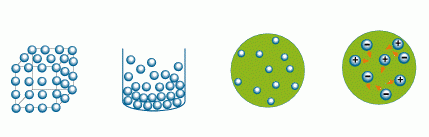
Consider water as an example. Solid water is ice. Liquid water is, well, water. We call water in its gaseous form "water vapor". A plasma created from water would include electrons, protons (hydrogen atom nuclei), and oxygen atom nuclei (protons and neutrons).

There are special names for most transitions from one state to another. Freezing is turning from a liquid to a solid; melting is turning from a solid to a liquid. The transition from liquid to gas can happen by boiling or evaporation. Condensation is changing from a gas to a liquid. Sometimes (usually at low pressure) a solid can become a gas directly (without first melting to become a liquid); this transformation is called "sublimation". Removing electrons from atoms (usually in a gas) to produce a plasma is called "ionization".

Stars are made of plasma, so plasma is the most abundant form of matter in the universe.

There are several other very exotic and unusual forms of matter that we don't encounter in daily life. A Bose-Einstein condensate can only form at temperature near absolute zero, and was first created in a lab in 1995. Degenerate matter can come into being under incredibly high pressure inside white dwarf and neutron stars. There are other very strange, very rare forms of matter as well.

Last modified June 25, 2008 by Randy Russell.

Run through this over view of "matter"- take notes


Now go to STRANGE MATTER


What do you think?


Thursday, October 28, 2010

Examples and Answers

Graphing examples

Interpreting Graphs 1 and drawing a graph from a "story!"

Example of graphing Distance (vs) Time

7th graders demonstrate inertia and motion.


A great review of Acceleration!! (and Newton)


Comments box is open...

Did you get these answers ?

Wednesday, October 27, 2010

Coral Video

Earth the Coral Sea

Goldilocks and Coral. hmmmm?

Picky Picky Picky


:

For as much as I love coral reefs, I've gotta admit that coral polyps are the prima donnas of the ocean. Most coral reefs are located between the tropics of Cancer and Capricorn--not much more than 30 degrees north and south of the equator. Not too far north nor too far south, but just right. Corals are also found farther from the equator in places where warm currents flow out of the tropics, such as Florida and southern Japan. Reef building corals grow best in waters with a temperature of between 21 and 29 degrees Celsius (70 and 85 degrees Fahrenheit). It is possible for soft corals to grow in hotter and colder places, but growth rates under these conditions are very slow. Again, they like it just right.

Tropical coral species are particularly fussy about temperature. As I've described before, when sea surface temperatures start to climb more than 2-4 degrees Celsius for an extended period of time, coral polyps get stressed and can expel their algal symbionts. Once the algae (zooxanthellae) are evicted, the translucent coral polyp appears white (or bleached). If temperatures remain elevated and the coral cannot reacquire new heat-tolerant algae, the coral may die.


But bleaching can result not just when conditions are too warm, but also when conditions are too cold. Some recent news from Heron Island on Australia's Great Barrier Reef describes how unusually cold weather has resulted in a winter bleaching event. Just the other day I described how the relatively rare phenomenon of sun-dried tides can cause mass coral bleaching and mortality. In a twist on that theme, if unusually low tides are coupled with chilly, windy (conditions that are just wrong for coral) a similar mass mortality can result. These images of bleaching are courtesy of Ove Hoegh-Guldberg's fantastic website Climate Shifts.


  1. Where do coral reefs grow?

Coral reefs can be seen throughout the tropical and subtropical Western Atlantic and Indo-Pacific oceans, generally within 30 degrees N and 30 degrees S latitudes.

  1. Why do you think that coral reefs only occur between certain latitudes, and then only within certain areas?

Studies have shown that most reefs grow well between the temperatures of 23-25 degrees C. The temperature is ideal year round in these locations, not too hot, and not too cold.

  1. What major factors limit where coral reefs can found? List 5 major factors limiting the occurrence of coral reefs and describe HOW these factors limit the establishment or success of coral.

Factor

Requirements

Why is it important?


Temperature

18-30 C (64-86 F)

Stable temperature between 18-30 C is necessary for the survival of coral reefs.

Salinity

33 - 36 parts per thousand


Light

The maximum depth for actively growing coral is 70m

The need for light for coral reefs� symbiotic plant is thought to limit reefs building corals to shallow water.

Wave action

Reef development is generally more abundant in area that is subject to strong wave action.

Waves carry food, nutrients, and oxygen to the reef.� Waves distribute coral larvae.� Waves prevent sediment from settling on the coral reefs.


Corals historically thrived in clear water, but recent bleaching events have revealed that water can be too clear! Corals need some nutrients and plankton for food, but not enough to promote algal overgrowth and rapid bioerosion rates.

The corals of the Florida reef tract provide clues to how “Goldilocks” these reef builders can be. The offshore reefs, where waters are clearest, have declined dramatically over the past several decades such that coral cover is now too low to sustain reef accretion. Only on patch reefs is coral cover at least in double-digit percentages.
Hallock, Pamela. " Goldilocks and the Three Biogenic Carbonate Minerals: What Determines “Just Right”?. College of Marine Science, University of South Florida

There is a greater variety of species in, on and around coral reef than anywhere else in the ocean. This is a link to Florida Coral Reefs

What would you do ? This is a "REAL LIFE " interactive about coral. Make decisions by yourself or with classmates


The Comment/Bonus box is open...

What do you know now?

What would you like to know more about?


How will you find out?

Monday, October 25, 2010

Coral Legacy

Coral in Peril

" There has long been a belief that the sea, at least, was inviolate, beyond man's ability to change and to despoil. But this belief, unfortunately, has proved to be naive. "
--Rachel Carson


How much do you know about coral?

Try a Worldwatch quiz or Ocean world - I like this one

What is coral? When you see pictures in National Geographic of huge rock like things in the ocean with fish swimming all around, is that coral? Well, sort of. That is a coral reef.


Take a Live FISH EYE VIEW.... look for yourself...

©1995 -2010 Quantum Leap Network, Inc. - All Rights Reserved

Coral is an animal that belongs to the phylum cnidaria. A phylum is a group that scientists place animals in which share certain characteristics. Cnidarians are radially symmetric, which means that they are the same all the way around, 360 degrees! They are built like sacs with a hole in one end that is surrounde

d by stinging tentacles. Jellyfish are cnidaria. Now, you are probably thinking, jellyfish don't look anything like what I thought coral was! That's because the most common pictures of coral are colonies called reefs.

During the mating season coral polyp release eggs and sperm into the water (picture below) and when an egg and a sperm meet they form a larva known as a planula.


Mountainous star coral (Montastraea faveolata) in the process of releasingboth eggs and sperm.

Click here for a larger view!


coral mating

The baby coral looks like a little tiny jellyfish and it floats around in the water until it finds a hard place to attach to, usually a coral reef. Then it lands and starts to build itself a shell. It builds it by combining carbon dioxide (CO2) and calcium (Ca) in the water to make calcium carbonate (CaCO3) also known as limestone. This shell is shaped like a round vase and the coral polyp lives inside.

bright yellow coral polyp

Coral Polyp
(Photo courtesy Jeffrey N. Jeffords)

Coral polyps are primarily nocturnal. At night a coral polyp will stick its tentacles out of its vase and let the tentacles wave in the current. Then, when plankton float by, the coral polyp stings them with its tentacles and brings the plankton inside its shell to have for lunch.

A coral reef is about a million of these individual coral polyp shells all stuck one on top of the other. When coral polyps die, new ones land and grow right on top of the old empty shells. There are over 500 different species of coral. Some look like brains and some like fans and some like the antlers of deer, but they are all made up of tiny coral polyps.

Organisms other than coral can form reefs. A reef is simply a structure in the shallow parts of the ocean that serves as a home to animals and plants. Many sunken ships have become reefs and humans even create artificial reefs to replace the coral reefs that we have destroyed. Some artificial reefs are specially constructed for the purpose, but others are made of tires linked together, old appliances linked together and even discarded military equipment like tanks and helicopters.


You can dive to greater depths in this adventure in the Coral Realm


Coral Reefs are often called : The Rainforests of the Sea ?

Can you explain what might make people say this? (Bonus points available)


The comment box is open

Sunday, October 10, 2010

Eureka Moments


EUREKA !!


Scientists from Ancient Greece - Did some REALLY COOL STUFF

Thales and some others - who may have started it all

And FAMOUS SCIENTISTS different lists and ways to search ...

How is this or how are they important to us today? What could we possibly have in common?

Well, For example: We are studying MOTION. 2500 years people were too...

Looking for evidence of acceleration and gravity? Have you ever REALLY watched water fall? Have you ?


Strato
(who died around 268 B.C., he is sometimes called Straton) did. he observed much more carefully than Aristotle, and realized that falling bodies usually accelerate. He made two important points: rainwater pouring off a corner of a roof is clearly moving faster when it hits the ground than it was when it left the roof, because a continuous stream can be seen to break into drops which then become spread further apart as they fall towards the ground.


Famous in the history of "Discovery" is Archimedes' shout... EUREKA!! .. truth or fable?
We are not certain,... but the math is proven!


We still use the word today.... ( and the math!)


We call them “Eureka” moments, sparks or breakthroughs, and we say things like “The lightbulb just went on.” We talk about good ideas as if they burst forth in one instant, and in one mind. But what if ideas are actually the works of hunches cobbled together and incubated over time?

This is how author Steven Johnson talks about ideas. He rejects the history books that tell romantic stories of inventors working alone in a laboratory, and instead presents stories of collaboration — of “ideas built on top of other ideas.”


In his book Where Good Ideas Come From: The Natural History of Innovation, Mr. Johnson traces seven centuries of innovation and argues that these tales of invention — a swath that takes in everything from the printing press to the Internet, the pencil to the flush toilet and an incubator made entirely from car parts — prove that an “idea is not a single thing, it is more like a swarm.”

“Ideas are growths of other peoples’ hunches,” Mr. Johnson said.

Read more: http://www.nationalpost.com/news/canada/Eureka+moments+really+come+flash/3646918/story.html#ixzz11yLZQ4bL

So what should one look for in a biography of a scientist?

Students should read about the phenomenon that was studied, how the experimental apparatus was configured, what was done with the findings, what specific errors and corrections were made, where ideas came from, and how the scientist’s colleagues, the public, the press, the government, or the funders reacted to the work. Students should be aware that scientists
encounter obstacles and experience setbacks as well as successes. Students should consider books that describe the work done by men and women in different areas of science, from various cultures, and who lived in different time periods.


Here is a great site to get one started searching for Great Women in Science... (yes, it is OK to play the games while you are at it)

The Web site iWASwondering.org is inspired by Women's Adventures in Science, a biography series for middle-school-aged students co-published by the Joseph Henry Press and Scholastic Library Publishing. Women's Adventures in Science chronicles the lives of contemporary, working scientists. Despite their varied backgrounds and life stories, these remarkable women all share one important belief: the work they do is important and it can make the world a better place.


....Many have made great sacrifices... often breaking social barriers along the way..


Scientists change and improve how we understand the universe... Sir Isaac for example..


Other links for scientists
Famous Scientists and a Time Line of Scientists, a TOP TEN LIST you might even find a video of your scientist here on "BIOGRAPHY"

Here is a site that was put together by another student working on the same project
Sizzling Smart Scientists .

Don't forget your textbooks may provide examples too!

The Light Stuff


Einstein's Big Idea homepage

Launch interactive The Light Stuff


the Comments box is open...

What have you discovered?


Have you ever had a EUREKA moment?


Who interests you most?

Wednesday, October 6, 2010

The Mangrove Connection

Click here for a quick trip to

MAN OH MAN OH Mangroves


Red Red roots


Black pirate fingers


Two bum
ps on the side


Red Red pointy head


Black Black Salt on back


White White no roots in sight.